

Design Team Takram: Pioneering A New World

Takram is an exceptional design group that’s been gaining tons of international acclaim. They provide innovative products and service using various genre including creativity, technology, business and culture. The O.N.S Japan team got a chance to talk with one of the founders, Kotaro Watanabe. He’s headlined and been involved with many creative and inventive projects, including a bookstore with only a single book and a soap that reveals hidden messages to the user. Mr. Watanabe uses both the right and left hemispheres of his brain equally, so he’s both a logician and a romantic. It’s clear he will be one of the leaders that will guide all of us into the brave new world ahead.
Can you briefly tell us what Takram does?
“Takram” (企) means to plan or to contrive in Japanese. We have roughly 40 members in Tokyo and 10 people in London. We’ve engaged in projects from designing Moon Exploration Rover to Japanese confectionery. We started Takram 10 years ago with a few people who wanted to combine engineering and design. As we completed several projects, more experts began to join us.
“We started Takram 10 years ago with a few people who wanted to combine engineering and design.”
What kind of professionals can we find in your team?
We have an architect, graphic designers, software engineers, hardware experts, interaction designers, mechanical engineers, graduates from art colleges, businessmen and so on. The variation of the people has been getting wider. Our common mindset is bringing on people who want to try new fields that they’re not specialized in. They are, in a way “social misfits,” in that they could not work at traditional companies (laughs), and so am I. Each member is ambitious about creating new categories instead of just making a new product. We all want to make a platform providing new values for the new world.
For example, one of our members, Sasaki used to work at a trading company for 10 years in Japan and studied in the U.S. to get a service design degree. He wants to create a balance between business and creativity at a high level. He is probably the designer with the most extensive knowledge in understanding financial statements in Japan. I myself want to create a balance between products and stories.
Can you explain what projects Takram is working on currently?
We are working on the first race for a robot moon exploration rover “Google Lunar XPRIZE,” hosted by Google. Competitors send the lunar roving vehicle to the moon and transfer image data from the vehicle to the earth. The first team to get it done will win. 16 teams from all over the world are participating, and Takram is supporting the only private Japanese company team “HAKUTO.” We’ve proposed the rover concept and design. (You can check out the details here.)

We are also in charge of art direction for Japanese kid’s educational program, “Mimicries.” (Check out the details here.)
Our branding business has been increasing recently. We’ve helped establish brands for Andaz Tokyo at Toranomon Hills and Lemon Hotel in Teshima, Seto Inland Sea. Now we are working on branding for Nihon Keizai Shimbun. We created ads for them to launch new stock price index “NIKKEI ASIA 300,” which indicates stock prices of 300 powerful companies in Asia. The ads were printed internationally in the British newspaper, Financial Times from Nikkei group.
Architecture and city planning are another field that’s getting popular for of us. Through researches and new ideas, we construct an entire concept for commercial facilities and city blocks in future Tokyo. In terms of the projects for the future life, we are also working on making prototypes of new transportation and home electric appliances.
Honestly most of our projects are confidential. Our projects with those companies won’t happen for 10 to 20 years, that’s why I can’t tell you a lot. What we can show online is just 20-30% out of all the projects.
What is the favorite project that you’ve worked on?
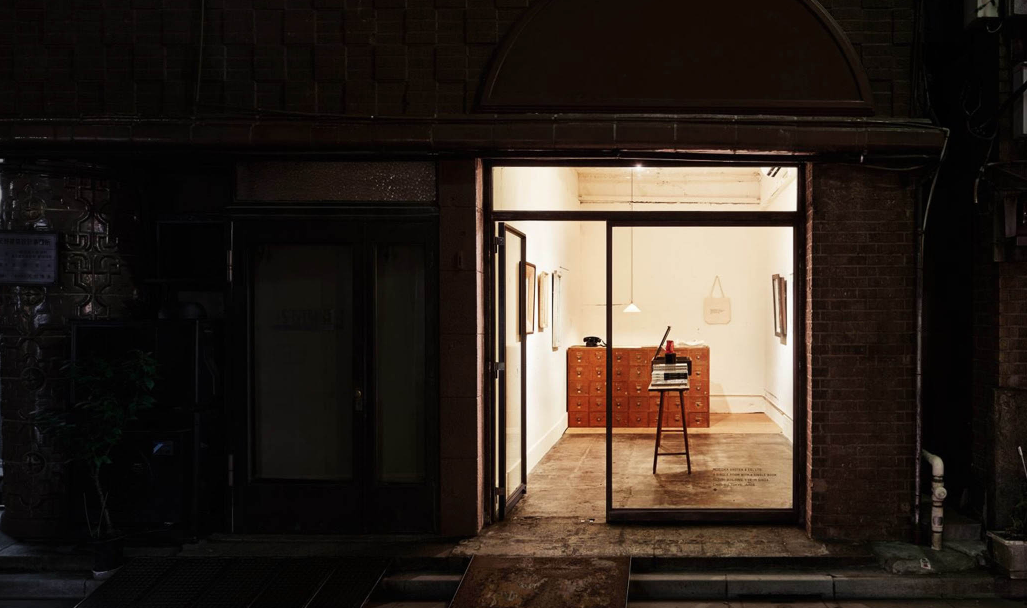
I am an art and brand director for Morioka Shoten, which opened in 2015. The owner Mr. Morioka had an idea that there could be a bookstore that only sells one book, so I helped make the actual store with him.
We opened the store in the Suzuki building in Ginza, which is one of the historic architectures officially chosen by Tokyo Prefecture. This building used to have the prestigious editorial production company “Nihon Kobo” where legendary Japanese photographer Yonosuke Natori and the master graphic designer Yusaku Kamekura worked. I thought it was important to show that Mr. Morioka admired the place itself, so I decided to include the address to the store logo, displaying the address in as big as the store name. The rhombus shape is the silhouette of an open book and an open room at the same time. The slogan “A Single Room With A Single Book” came from this symbol as well.
The Morioka Shoten project received 4 awards, including 2016 Good Design Best 100, iF Design Award 2016 (Germany), and D&AD Award (UK.)
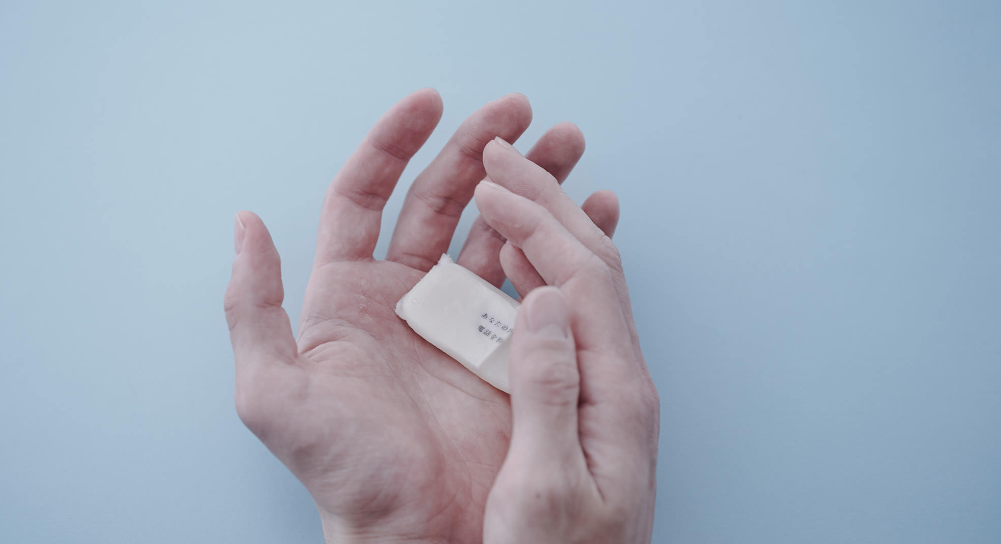
We also worked with an organic cosmetic company “Lalitpur.” They use materials from Nepal. I invented gift soap “Massage Soap, in time.” After you use the soap for a while, you can find a message inside. There are 7 types of messages and you can write your own words too. For example, if you want someone to get a birthday message in a soap bar, you have to give the soap to him/her in advance, because obviously in the beginning you can’t read it. It takes around 3 weeks of use to reveal the message. I want people to enjoy even the error of the timing. You can send it to your family living together or loved-ones living far away.
The other day, I sent a lot of “Message Soap, in time” to people who have helped me with individual messages. I’ve been hearing from them saying “Eventually I found the message!” The soap widens communication with others.
What is it about “making both products and stories” that you find so important?
For example, the story emerges when a person feels the book found in Morioka Shoten is a fateful encounter. Two people who interact through a message in soap have a story too. The story is when they talk and what they communicate through extra linguistic ways. It is important to involve not only senders, but also the receiver into making a story. That moves people’s heart. The story emerges away from designers.
I think it’s similar to the concept of Haiku (Traditional form of Japanese poetry). A Haiku is a short poem with only 17 syllables, but it’s filled with the sender’s passion. The receiver has to read and decode the poem with the same level of creative energy as the sender, so that one can understand or interpret the message, whether right or wrong. The sender and the receiver work together to experience the impression and inspiration asynchronously, which results in their own collective story.
Good designers have to help change a receiver to a sender. I want people who use products to be active. I want to offer the chance to them so that they can start to make their stories. The moment stories occur is beautiful. I really want to see it, be involved in and make a perfect setting for it. I call this effort, “Context Design.” What I want to achieve is creating the new genre of “Context Design” and “Making products and stories.”
That’s why I’m fascinated more by Haiku expressions, and not movie expression.
“The sender and the receiver work together to experience the impression and inspiration asynchronously.”

How did you get interested in this job?
In my college days, my school was located in the Shonan area, and I lived in Tokyo, so it took 3 hours to commute. I borrowed three books a day at the library and read them on the trains. After I read a lot of different types of books, I turned to books that cannot be classified, i.e. short, un-labeled books. They were strange but so interesting. A book written by a paleontologist, Stephen Jay Gould, combined science and the romanticism of living on earth. I also liked the essay written by a physicist, Torahiko Terada at Tokyo Imperial University, who was an apprentice of Soseki Natsume, a Japanese novelist in the 19th Century.
I realized that anything involving various elements that defy classification is very interesting. So,for the projects, the things that are impossible to apart are the essence. At a glance, you may not find it, but there is a special aura inside “schizophrenic” elements. I used to live in Hong Kong when I was a junior high school student, and Hong Kong also possesses a special culture which is not a mere addition of China and the UK. After the college, I also worked in Brussels where Dutch culture meets French culture. I rather felt sympathy for people who want to blend multiple categories in the way that I have never seen than I was interested in design engineering itself. That’s why I decided to take part in starting Takram.
I think innovation is born in that kind of place, and we need to be brave. It’s totally new, so not everybody will understand. Some people feel suspicious or scared. Our dreams of inventing new categories may sound slightly fragile or naive, but with the team, the scary feeling dilutes. I’d like to challenge the norm and create innovation with my 50 “social misfits” and provide new values for the world.
What do you do on your days off?
I like to share with other what I’m enthusiastic about, such as art or literature, and to listen to what others are into as well. I met a poet, Bin Sugawara, the other day and talked about books and movies. For example, we chatted about Italian writer Antonio Tabucchi, French poet Jacques Prévert and Japanese cartoon writer Osamu Tezuka.
Last week I went to a workshop hosted by the successor from Shino-ryu, one of the incense burning ceremony schools. I had a chance to smell one of the best 61 Japanese traditional aromatic trees, which Yoshimasa Asihkaga ordered Shino-ryu’s original head in the 15th century. That was very special experience. I also smelled Shibafune which Masamune Date loved and wrote a poem about, around 300 years ago. Being able to smell the incense of the very same tree that a past Shogun once touched, is something quite extraordinary.
Speaking of Masamune Date, he is known for half blind daimyo (a feudal lord.) I got a chance to actually see and touch a black tea bowl that he used to use. The shopkeeper of the vintage store said to me “The tea bowl allows you to see the same view as the old owners. Try to close your one eye. You can see the same view as Masamune Date.”It’s romantic, isn’t it? I’ve been practicing the tea ceremony for about 10 years, and I’m going to host two ceremonies this month.
Do you have any favorites in the world of fashion?
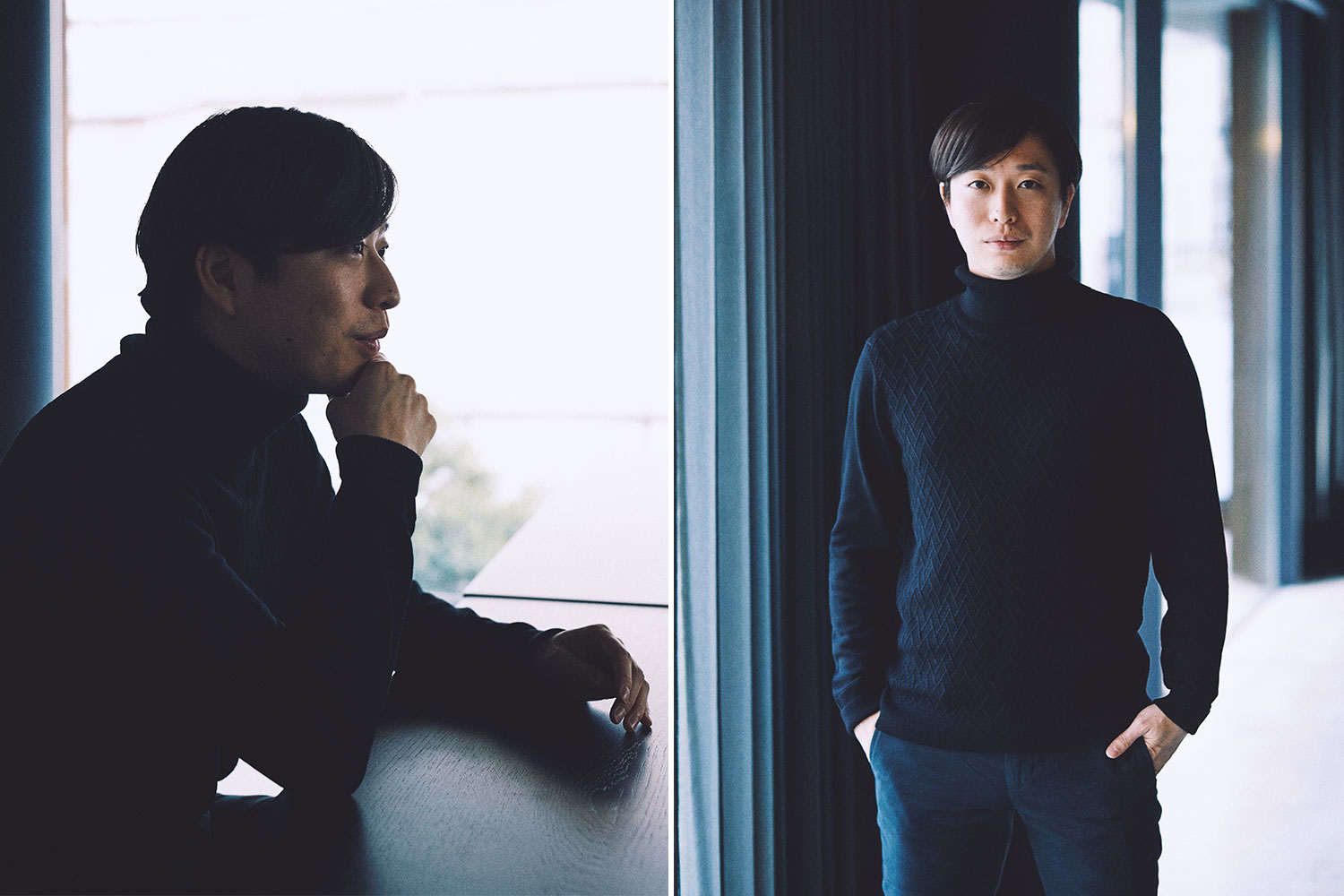
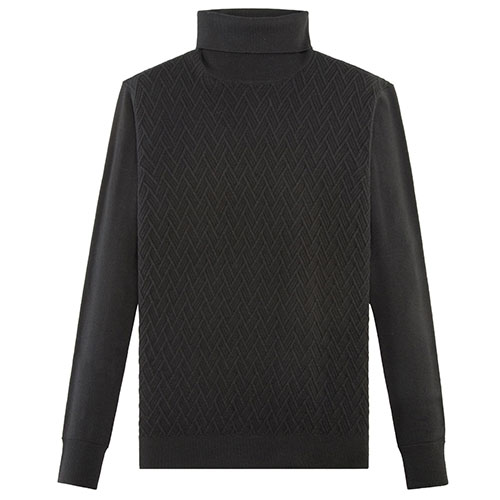
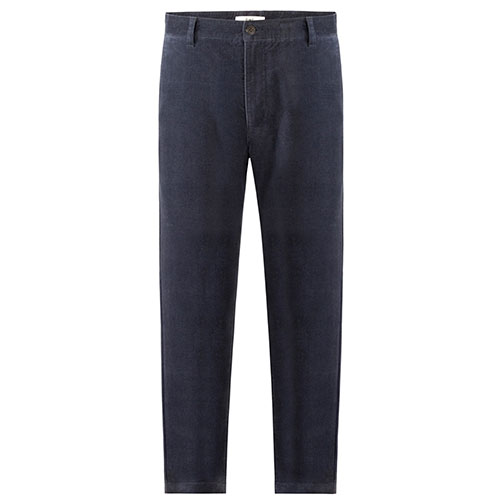
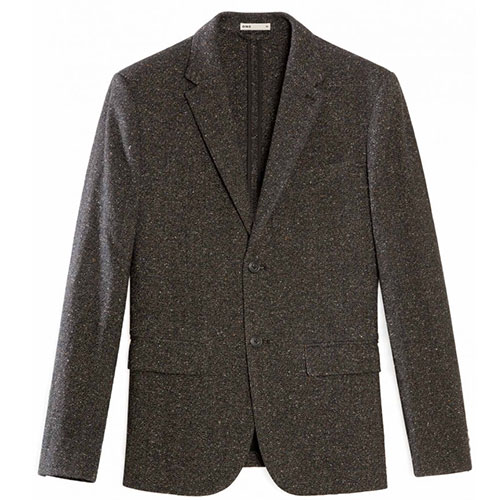
I like the brand, THE INOUE BROTHERS. They’re Japanese Swedish brothers that make knitting products made by royal alpaca. I like wearing their clothing and I met the brothers through my friend and liked them even more since now I have personal connection with them. I have a lot of their items, including sweaters, which I’ve been wearing for a few years. The hand feel is very good.
I like dull purple. I like the color called “moon dust” from a French ink maker. The color is akin to wine dregs. So I tend to buy purple color fashion items.
Is there any difference between work clothes and after-hour clothes?
Not really. I have a lot of suits, but rarely wear them (laugh.) So I tried to wear suits for casual days like “Formal Wednesday.”
I like clean and a minimal formal wear even for weekends, so yeah, there is no big difference between weekdays and weekends.

What is your favorite music?
My recent favorite is Robert Fripp / Brian Eno’s “Evening Star.” I also like Brian Eno’s “Music For Airport.” It’s so beautiful. I also like the fact that it was actually composed to be played at some airport, and it’s now still being played there.
I like to ask about songs played in the city. I always ask “what is this song?” to people at boutiques and restaurants. Then I buy them online later. The day before yesterday, I heard a Serge Gainsbourg at a French bistro. I downloaded it and listened to it on my way home.
What exciting plans do you have next for Takram?
I want to make London’s business more stable. Eventually, we want to open the third branch either in Singapore or New York.
New York has a mature design industry. I think we will fit in East Coast more than West Coast because their cultural accumulation and sense of value are similar to ours. In the past, I visited NYC several times. Once I attended a press conference when MUJI launched their first iOS application, which we helped to plan and develop. I also exhibited my products at Cooper Hewitt, Smithsonian Design Museum in a design triennial. I want to go there again soon.
For more information, visit the Takram official website by clicking here.
All Photos by Yosuke Suzuki (Erz)
Text by Akihiro Tajima
If you liked this story, check out more in our Urban Transplants issue.


