
Meet Justin Dean Thomas, Roots Musician for the Modern Age
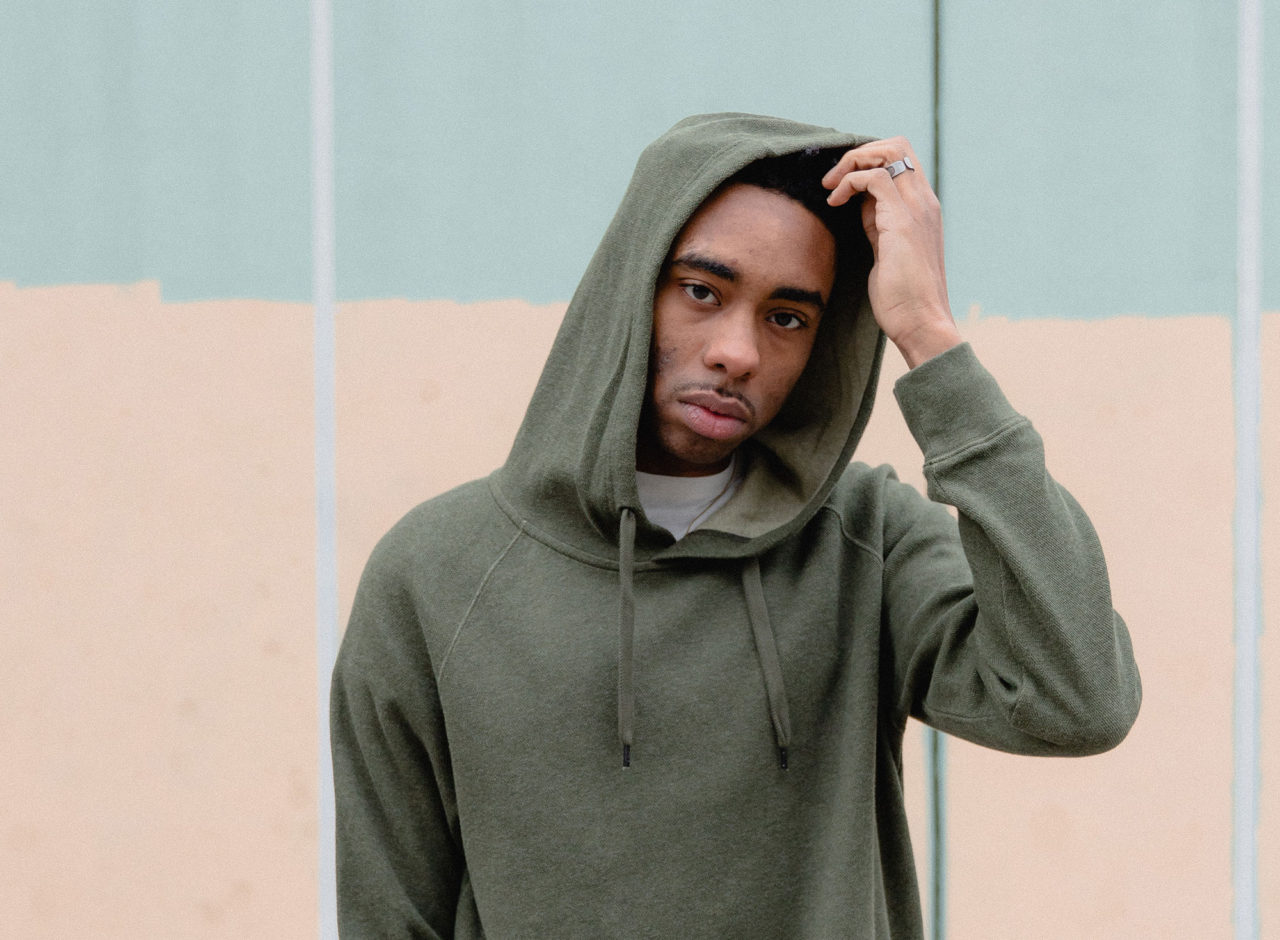
In a world where manufactured pop stars get more and more of the attention, Justin Dean Thomas stands out for his authentic commitment to himself. Writing songs that draw on personal experience, his lyrics are poetic, and his music is intense, drawing on traditions like ’50s rock and even country blues to create a sound that’s wholly his own and completely modern. To talk music, writing, and even style, we had Justin swing by our SoHo flagship a couple weeks ago. This is what we discussed. 
Your music has tremendous energy, but the lyrics are also very poetic and specific. Is that juxtaposition intentional? Do you feel like those sort of different aspects strengthen the whole?
For me, it’s important that I can see what it is I’m writing about. If I can see it or live in it while I’m writing, then perhaps someone else can jump into it when they listen. Most of the time, I can hear the melody and see what’s going on as I write the song. I can see the colors, what the sky looks like, what the air feels like… what is on the dresser or in the kitchen sink… how the trees sway in the song. But I can’t take someone anywhere I have not gone myself. So it’s not so much intentional what I try to produce, but rather where I try to go. The lyrics and melodies are a byproduct of that. Poetry has always been a love language. I think diet is key as well; what you stock up on, what you read, your eyes, ears… what you behold. They are resources but not source.
Your music is very contemporary sounding, but older influences, like punk, garage, ’50s rock and roll, and even country blues seem to be strong too. How do you take those more historical influences and update them so they sound so fresh?
I often cruise down long paths of an era… steep myself in it. All the constituents of that era. I would find old magazines at yard sales from an era. What were people aware of? What were they being sold? What were they listening to? I study the fashion, the literature, film, architecture. Human beings always want the same things from era to era. The only thing that’s different is that the culture changes. Human conventions change. There are things we brought from the ’40s to the ’50s that maybe the ’90s didn’t bring to 2000s. There are so many similarities I can hear in the songs, whether I’m listening to The Replacements from the ’80s, or Big Star from the ’70s. I feel like certain things are extracted out of an era without the context. The context is key. It makes up a whole of why or how something was born… a movement or a sound or a feel. There is a spirit of the times so to speak. It isn’t the one you always currently hear or see, but that’s usually what brand new music sounds like to me. It’s not necessarily looking at who is currently making music, but the music that hasn’t been made. Not tapping into what people want to hear, but what they haven’t heard in a long time, or ever at all. It’s not pure to a form. It’s not trying to replicate a sound, but honoring what came before without being contrived or too intentional. There’s so much noise and distraction within content; some with substance but no context and some with context but no substance. Most things are cut and pasted, but some things come straight from the heart and that affects the heart.

As a musician and artist, how important is fashion and style to you? Do you look at it more as another expressive aspect of your work or do you see it as personal branding which helps strengthen your product?
I’ve always loved clothes. I always knew I wanted to play music professionally ever since I was a little kid, partly because I could wear whatever I wanted to work. Clothes and music are seamless in my mind. So I see things from different eras of time and it usually matches what I’m feeling or seeing with music. I have a few places I like to go, most of them vintage shops in Manhattan and Brooklyn. I will see something and then ideas just kind of pop up of what would go well with that piece. But it’s nothing I think about too much. It just flows. There are so many cool little hidden gems in thrift and vintage shops. I like to find new designers that are making something different and pair it with the old.
What’s one item of clothing you feel like you could never live without?
Vintage combat boots.

When we shot photos the other day, you mentioned you were recording a new EP on reel-to-reel tape. That sounds so cool to me! Can you talk about that and what you have coming up?
Yeah, I’m super excited about this EP. I’m working with producer Lucas Carpenter on a four (maybe five) song EP to be released by March or April of 2019. Lucas played a lot with me live and he knows the ins and outs of how I work, so we get a lot done in a short amount of time. We flow together. Some of it was shooting from the hip as we recorded in a few different studios on the fly. When you’re recording analog, on tape, it changes how you attack the session. We try to stay away from multiple takes. We aim for live takes and are efficient with what we have. Lucas was talking about the power of limiting options, and he has a “no bullshit” way of chopping it with the right axe and making sure we followed through and got it the first time. In times past I don’t think I would have been able to be as malleable or liquid, but I’m at a point now where I feel comfortable enough to adapt to what’s in front of me. The sound is different. Analog as the first step, I think, is key. It’s like analog film. It’s an actual physical imprint of the sound on tape, rather than a binary approximation. I’m not a purist. I think there are advantages to both worlds. It’s just I’ve always wanted to make an analog EP or album and that’s happening. I’m really blessed to have Brandon Collins and Corey Hines playing these tunes with me. My girlfriend, Ana Cristina, also played her first show with us recently. So there are a lot of friends and people I respect that are all making this next push happen, and I’m really excited to release this EP… it means a lot to me.
If you enjoyed this story, check out our Urban Transplants issue here.